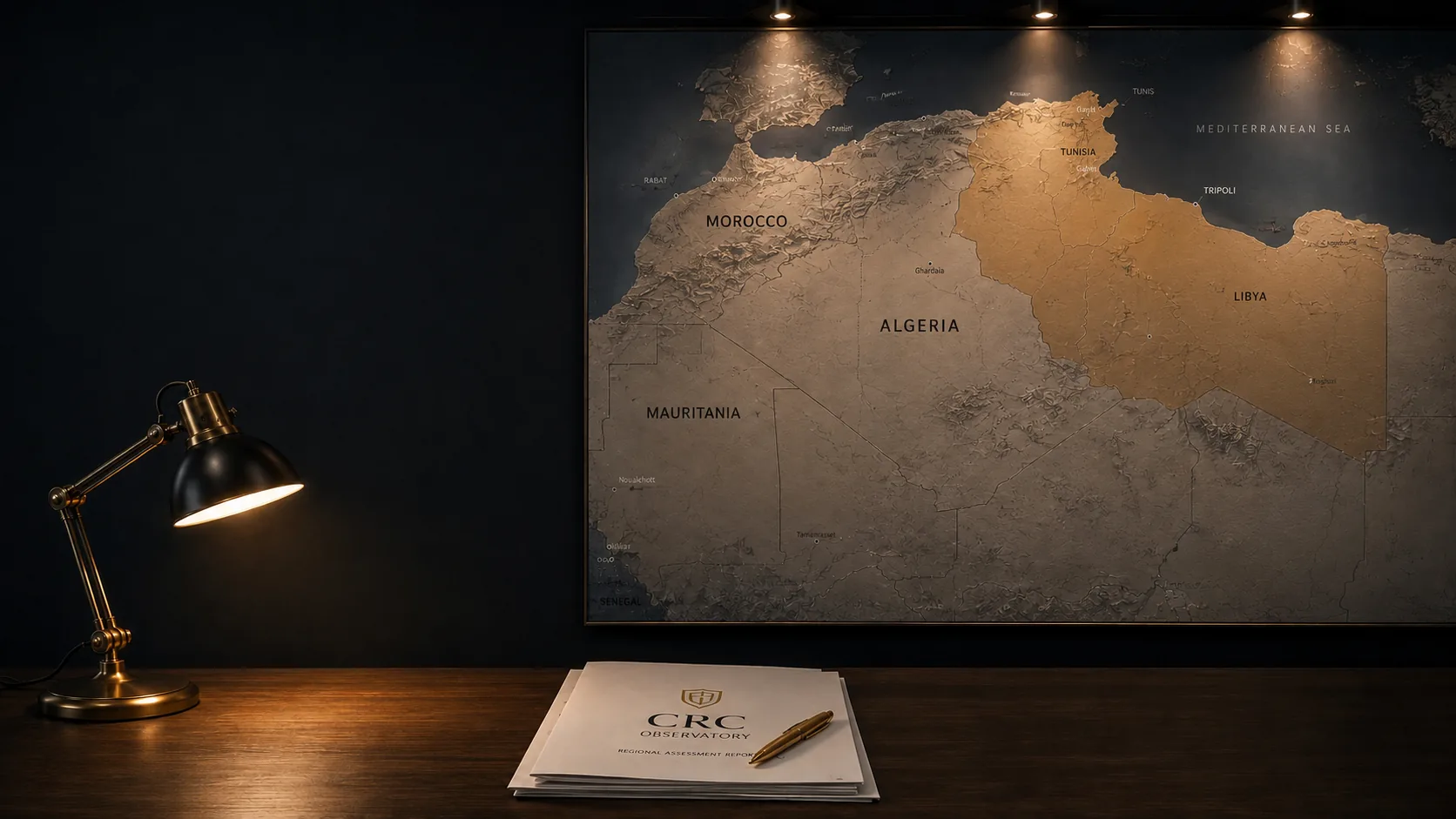
Governance, workforce and continuity, read against commercial exposure rather than issued as regional commentary. Tunisia, Algeria and Libya are covered continuously. Other countries in the region are assessed on instruction.
Carthage Watch
What the firm is watching. Continuous observation of the operating environment, indicators, and early warning against a client’s known exposure.
CRC Observatory
What the firm thinks. Assessment, interpretation and decision support, where a position is taken and the reasoning behind it is made visible.
North Africa and the Sahel
Selected
Covered continuously
Assessed on instruction
Outside current coverage
Select a country. Boundaries drawn from Natural Earth. The boundary shown in the Western Sahara is drawn as undetermined and no sovereignty is implied.
Country snapshot
A standing read across five areas for the three countries under continuous coverage. Each band reflects the indicators set out in the assessments above and is reviewed at every data cutoff.
Last reviewed 5 September 2026 · Next scheduled review October 2026 · Tunisia, Algeria and Libya under continuous coverage
Tunisia
AreaStatus
GovernanceWatch
Regulatory environmentWatch
WorkforceWatch
Integrity and ethicsWatch
Business continuityElevated
Executive overview
Tunisia offers a comparatively mature operating environment within North Africa, supported by established institutions, a capable workforce and a diversified economy. The binding constraint is administrative rather than physical, with one exception. Utility performance through 2026 has been the principal continuity concern and is the reason the continuity band sits above the others. Organisations should monitor regulatory developments, workforce dynamics and administrative reform when planning beyond the current year.
Libya
AreaStatus
GovernanceElevated
Regulatory environmentElevated
WorkforceWatch
Integrity and ethicsElevated
Business continuityElevated
Executive overview
Libya presents real opportunity in selected sectors while requiring careful assessment of governance conditions, operational continuity, stakeholder engagement and regulatory exposure. Authority is divided, and the practical question for a company is not who governs the country but who controls the specific site, route and counterparty in question. Organisations should adopt a structured risk management approach before any material commitment.
Algeria
AreaStatus
GovernanceWatch
Regulatory environmentWatch
WorkforceWatch
Integrity and ethicsWatch
Business continuityWatch
Executive overview
Algeria benefits from a large domestic market, strategic regional weight and substantial state resources. The principal source of friction is administrative rather than security related, and import control, customs performance and utility supply through 2026 warrant monitoring alongside sector specific opportunity. Organisations should treat documentation discipline as an operational control rather than a clerical matter.
Observatory status legend
Stable Conditions generally support planning and operations.
Watch Developments warrant monitoring and periodic review.
Elevated Enhanced assessment and mitigation measures are recommended.
Bands are assigned from the indicators published in each assessment on this page and are reviewed at every data cutoff. They describe the operating environment in general terms and are not a rating of any company, site, route or counterparty. Morocco, Mauritania and Senegal are assessed on instruction and are not banded here.
Who this is written for
The Observatory is read by people who carry a decision, not by people following the news. Four in particular.
Companies bidding donor-funded work
Tenders funded by development banks, European instruments or United States agencies increasingly require an integrity, security and continuity annex before a bid is admissible, and conditions that bite again at mobilisation.
Used for: bid annexes, counterparty screening, mobilisation planning.
Investors and operators entering the region
Entry, expansion and site decisions turn on whether an environment is administratively workable, not on whether a country appears in the news. The distinction is where money is lost.
Used for: entry assessment, site selection, board papers.
Insurers, lenders and legal advisers
A position taken on a country has to be defensible later, to a committee, an underwriter or a regulator. That requires stated indicators, dated sources and a published basis for the reading.
Used for: underwriting files, credit committees, compliance records.
Organisations with movement and logistics exposure
Non-governmental organisations, agencies and their contractors moving people, vehicles and cargo, principally in Libya, where the operative question is who controls the route rather than who governs the country.
Used for: route and convoy planning, site security, duty of care.
Access
Executive summaries are open. Scenario work, risk matrices, due diligence examples, methodology and case-study material are held for subscribers and clients.
Essential Access
For organisations tracking the region at a distance.
Enquiries are reviewed by an analyst. We reply with access options, scope and terms.
Data cutoff. Assessments on this page carry the date shown against each summary. Conditions change and a summary should not be read as current beyond its cutoff.
No reliance. Material on this page is general assessment published for information. It is not advice on any particular transaction, posting, investment or individual, and no duty of care arises from reading it. Decisions with material consequence should be taken on a commissioned assessment.
Sourcing. Assessments draw on official statistics, multilateral reporting, published legal instruments and open reporting, interpreted by the firm. Principal sources are listed with each assessment. Where a figure is modelled rather than reported, or where credible sources disagree, this is stated in the text.